
Section 4.0 – Assessment
Almost all business that handle or sell food to the public in Australia must register as a food business with their local council and maintain a food safety program.
In Australia we have modelled our food safety program following the HACCP method.
HACCP stands for:
HAZARD
ANALYSIS
CRITICAL
CONTROL
POINT
The HACCP model is a logical and efficient way to control food safety, and to help us ensure good hygiene.
HACCP is an internationally recognized system for reducing the risk of safety hazards in food.
A HACCP System requires that potential hazards can be identified and controlled at specific points in the process. This includes biological, chemical, or physical hazards. Any company involved in the manufacturing, processing, or handling of food products can use HACCP to minimize or eliminate food safety hazards in their product.
HACCP is mandatory in Australia for all food businesses in Australia that serve and sell food to their customers to ensure that is safe and free of contamination of any kind.
Critical Control Point:
A Critical Control Point (CCP) is a step or procedure which controls can be applied and a food safety hazard can be prevented, eliminated or reduced to acceptable (critical) levels.
Examples of Critical Control Points in food production where controls can be applied are:
Receivals
Storage
Preparation
Cooking
Cooling
Display
Serving
Transport
4.0 HACCP Terms and Definitions
H.A.C.C.P. stands for HAZARD ANALYSIS CRITICAL CONTROL POINTS
4.1 What is HACCP?
HACCP is an approach to Quality Assurance & food safety that identifies & prevents problems before they occur.
It involves a hazard analysis of the potential food safety hazards in the chain and develops systems and critical control points to eliminate those hazards or reduce their risk.
An audit of the process will require conformance to State Health Legislation soon.
4.2 Background
From 1999 most states will introduce new food safety legislation that will require all food premises (including distributors and or who participate in the production and handling of food) to implement A.C.C.P. based food safety programs and hygienic food handling practices.
4.3 Definition Clarifications
Hazard – means any microbial, chemical or physical property that has the potential to cause harm to humans.
Hazard Analysis – means the identification and assessment of the above hazards within the food premise.
Critical Control Point – means a step at which control can be applied and a hazard prevented, reduced or even eliminated. Similarly, it is a point where loss of control may lead to a safety problem.
4.4 The 7 H.A.C.C.P. PRINCIPLES
When HACCP was designed by NASA in the 60’s, they came up with a methodology that guaranteed 100% Food safety if all 7 principles were adopted by a food manufacturer or handler of food. They are…
Conduct a Hazard Analysis
Conduct a Hazard Analysis
Identify the Critical Control Points (C.C.P.’s)
Set Critical Limits
Monitor the C.C.P.’s
Take Corrective Action
Verify that the system is working (including audits)
Set up Record Keeping Systems Verify that the system is working (including audits)
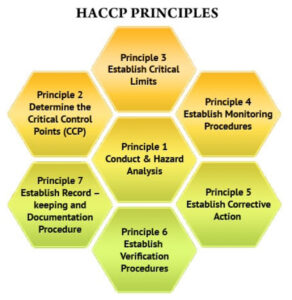
Your role in HACCP Principles are to:
1. Conduct a Hazard Analysis
For example when receiving stock we conduct a hazard analysis by checking the condition and temperature of the delivery vehicle and the quality and temperature of the stock.
2. Identify the Critical Control Points (C.C.P.’s)
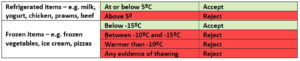
At Drakes our first C.C.P is the receival of stock, including the critical limits of temperature. C.C.P’s also include the storage of cold rooms and freezers and the cooking of stock.
3. Identify Critical Limits
The critical limits for temperature of deliveries are below:
4. Monitor the C.C.P.’s
The Critical Control Points are monitored by completing temperature checks, quality checks, date checks and the temperature and condition of delivery vehicles.
5. Take Corrective Action
If a delivery does not meet the critical limits a corrective action that would be taken is rejecting the delivery to prevent the products causing a health risk to customers. Deliveries are rejected and a Form 42 Non-Conformance Letter must be completed to be given to the driver.
6. Set up Record Keeping Systems
All deliveries are recorded on the Form 41 Inwards Receival Record and if any deliveries are rejected a Form 42 Non-Conformance Letter must be completed to be given to the driver, as per take corrective action. All temperature checks of chickens is completed on the Deli Food Safety Forms.
7. Verify the system is working (including audits)
Drakes Workplace Health and Safety Officers regularly complete internal audits in all Drakes stores to check the HACCP system is working and all team members are complying with food safety policies and procedures. Drakes participate in food safety local council and safe food QLD audits.
Assemble the Core H.A.C.C.P. team
Describe the products
Identify their intended use
Develop a process flow diagram
Verify that diagram
List all potential hazards
Establish critical control points
Establish critical limits
Establish a monitoring system
Establish corrective actions
Establish verification procedures
Establish record keeping
What can happen if HACCP principles are not followed?
If the HACCP principles are not followed, product may be contaminated and bacteria will grow, this can result in consumers becoming ill with food poisoning. Food poisoning is caused by bacteria, viruses, or toxins in the food we eat. Some of these toxins are found naturally in foods, while some have accumulated in the environment.
Different bacteria and viruses can have different effects:
Salmonella: gastro and flu-like symptoms usually appear between 8 and 72 hours after eating the infected food and last for two to five days.
Campylobacter: gastro symptoms appear in two to seven days and last about five days.
Listeria: gastro or flu-like symptoms usually appear after about three days for milder cases and up to 70 days for the severe form, with the illness lasting longer if it is more severe.
Norovirus or Rotavirus: severe gastro or flu-like symptoms usually begin 24 to 48 hours after exposure and last one to three days (norovirus) or up to eight days (rotavirus).
E coli: gastro symptoms usually appear in three to four days and last about a week.
To avoid our customers becoming ill with food poisoning we must ensure we always follow the HACCP principles.
Three Types of Food Hazards
Food Spoilage is caused by one of the following three conditions.
Physical hazards:
Presence of foreign matter such as hair, dust and insects falling into food
Damage to the protective layer of a food item such as eggs with a cracked shell or dented cans
Moisture loss
Moisture gain
Aroma loss
Odour absorption
Chemical contamination:
Cleaning substances have not been properly removed from surfaces or equipment
Cleaning chemicals are stored incorrectly near food
Pesticides are used on fruit and vegetables during the growing process
Insect repellents are used incorrectly
Enzyme changes
Micro-organisms:
When bacteria, yeasts and moulds grow on or in the food
Food Spoilage is a visible deterioration of food. You can tell when food spoilage has happened by the smell, look or taste of the food. Examples of food spoilage include sour milk, mouldy bread or slimy meat.