
Section 11.5 Fresh Departments: Refrigerated Service Display Practices
The pupose of this section is to ensure packaged or un-packaged foods sold in refrigerated service displays are stored, handled & displayed in a manner that does not compromise food safety or quality.
This procedure covers all packaged and unpackaged products that may or may not have been processed in-store, which are sold from refrigerated service display cabinets in the Deli & Meat Depts.
Responsibility
The Delicatessen and, where applicable, Meat Dept Managers are responsible for ensuring that all staff directly handling foods in service display cases are adequately trained in this procedure and for the update of this document as required.
Hygiene Culture
In all procedures, general hygiene principles detailed in – section 13 of this manual apply. The options of maintaining a hygienic food handling culture are detailed below.
Gloves
Disposable gloves are common in all food business and their main purpose is to protect the foods from any cross contamination.
Gloves should be changed when alternating between ready to eat foods and raw foods. Poultry, seafood including shellfish and fish fillets.
The use of approved clean, dry, disposable plastic gloves is essential when there are no other protection mechanisms for the handling of foods and is usually a last resort. Gloves are to be used on both hands during one-stop processing operations such as slicing, or preparation of recipes.
Gloves are changed as often as is necessary to prevent cross- contamination of different species of meats, not just necessarily between customers. It is the responsibility of the Dept. Manager to ensure that all staff directly handling foods maintain a strong food safety culture & strictly abide by all company hygiene requirements whilst wearing gloves.
When using disposable gloves, it is important to:
- Wash and dry hands thoroughly with soap and warm water and dry them with paper towel
- Apply gloves
- After removing or changing gloves, wash hands thoroughly again
It is also best practice to wear gloves when:
- You have any adhesive dressing such as a band aid on your hands
- You have any nail polish
- You are wearing any permitted jewellery
Important things to remember when using gloves
- Gloves must be changed regularly – between every customer as stated above after handling any product which will cause cross contamination.
- Must be changed between jobs to reduce the risk of cross contamination
- Must be disposed of once they are removed – they cannot be re-used
- Must never be washed for further use – they are a disposable item and must be thrown away
- Artificial or long fingernails may cut through the gloves rendering them ineffective
WHAT DO WE DO AT DRAKES?
- All fresh food areas are provided with disposable gloves
- Information on storage and use of gloves is provided to all staff on induction
- When serving customers, tongs should be used along with gloves, product should never be handled by hands. Use the appropriate tongs for the section, place the product on the scale using deli paper. Selected product e.g. poultry, seafood and bacon pieces can be placed in a bag. This is to be taken from the display using the inside of the bag with your hand, but you must be wearing gloves. If you need extra stock in the bag use tongs to fill.
- Due to gloves touching the scale keypads when serving, you must change gloves between customers or during products which will cause cross contamination, whichever comes first.
Single-purpose plastic sheets
These may be used with care as an option to protect against direct hand or surface contact with foods. One approved single-purpose sheet is to be used at a time.
Bag inside out – Inverted bag
Another option is to use approved disposable plastic bags turned inside out to avoid direct contact with foods. Like plastic sheets, this can be a little clumsy or difficult with some foods, but in specific areas can be very effective.
Tongs- cold
The use of tongs in refrigerated displays must be well managed to ensure that direct hand contact is avoided as best as possible, and that the tongs are maintained in a fit state for food use. Tongs should show no signs of damage, rust etc, and be made of non-porous plastic or stainless steel. Enough tongs must be supplied to provide for a culture of adequate segregation of use between different categories of foods in the same display cabinet to avoid cross-contamination. The Department Manager or their delegates must review the state of the tongs daily to ensure they are kept visually hygienic. It is recommended that busier displays carry two sets of tongs for this purpose.
Tongs- hot
Tongs must not be stored in any hot displays. Tongs used for hot foods must be kept in a plastic container filled with sanitiser, next to the display. One set of tongs is adequate for all hot foods. The container and the tongs are washed every 3 hours during trading and the container is re-filled with fresh sanitiser. It is recommended to use the no rinse sanitiser – Sanibac is used for this. NOTE: Periodical swabs by Dominant can be used to microbiologically validate the above system.
We have specifically coloured tongs and boards for different uses:
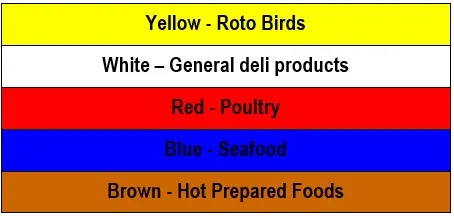
- Chopping boards must always be used alongside slicers
- No product is to be cut or open on a stainless-steel bench
Storage and handling
Upon receival, all refrigerated foods are stored in the coolroom until required for display. Each pack may be either marked with a receival date or re-arranged to a separate location in the coolroom to facilitate effective stock rotation.
All Deli stock being placed in the coolroom is documented on Form 46 – Traceability Record Sheet to ensure FIFO (First in First out) is observed.
When the product is required, the operator removes a pack from the coolroom, cuts open and empties the required quantity into a clean, dry plastic display tub / tray.
No refrigerated goods are kept out of refrigerated storage for longer than 15 minutes.
All products placed in the case are recorded on the Deli Traceability Sheet – Case (Form 39) to identify the date of preparation or filling of that tray, if the goods are deemed to have a shelf life of 48 hours or more, according to the attached recommended list (below), to ensure traceability & quality standards. All products are them immediately placed into a refrigerated display cabinet.
All display set –up practices must ensure that raw and cooked or fermented meats are adequately segregated as best as is feasible to minimize risks of cross-contamination. It is preferable to segregate in separate displays but where this is not possible, a perspex divider is to be used.
Products with different date codes are unpacked into separate, clean trays when the stock in the display cabinet is low. Older stock is to be reviewed & may be placed on top of a tub of new stock and segregated by a Slap Sheet when the plastic tub is replaced, to facilitate effective rotation of stock.
At the end of the day, selected trays of products in the service displays may be covered with stretch wrap, placed on a rack and put in the coolroom until the next morning. This is optional. If this is not done, then stock remaining in the refrigerated displays is covered with disposable plastic sheeting to avoid drying out.
When staff remove the stock from the coolroom at the beginning of the next day’s trading, they must check each tray of previously displayed product to ensure that it smells, looks and even tastes fresh & appealing to the customer. It is always best to maintain the principle: “If in doubt, throw it out”, regardless of shelf life. All stock that is dumped must be weighed first and recorded as waste.
NOTE: The importance of this check cannot be understated as from time-to-time, quality variations in products will mean that they must be removed from sale prior to their intended expiry date. A good way to look at it is: “If you would not buy it, then don’t sell it”.
The use of ice, plastic dividers are reviewed daily by the relevant Manager and must not increase the risk of food contamination by their use.
Temperature checks on all refrigerated coolrooms & displays are recorded three times a day and recorded on the relevant check sheet. (Form 19)
Service Display Categories – Maximum Shelf Life
- This list is the maximum amount of time, after opening the original package, each category of goods is recommended to be kept in a service display cabinet, at or below 40C, before being sold.
- Unsold stock approaching its maximum display life is to be marked down for sale prior to the recommended limit, not after.
- Reserve stock in the coolroom, opened & re-sealed will last longer but must be reviewed each time the service display is re-stocked with the open product. All opened products must be labelled with a traceability sticker noting use by and opened date.
- Quantities in the service display should be based on how much you expect to sell in the recommended maximum time allowed. Stock quantity should be adjusted to reflect anticipated trade. Less more often is better to keep freshness and eliminate waste.
- Before opening original packages, you should check the quantity in the service display, and any opened stock in the coolroom (if applicable), to ensure that it is required.
- It is everyone’s responsibility to eliminate waste.
- For control of batches on display the Deli Traceability Sheet – Case (Form 39) sheet is to be used.